

We are very excited to announce the availability of the HoundDog.ai connector. The Brinqa platform unifies assets and exposures across infrastructure, cloud, and applications, and can now ingest PII leak findings and PII inventories from HoundDog.ai.
HoundDog.ai is a static code scanner that proactively maps out sensitive data flows and identifies unintentional developer mistakes that lead to overlogging or oversharing of PII across logs, files, and third-party integrations. The new connector lets Brinqa users add PII leak prevention and privacy compliance directly to their existing risk management workflows, enabling organizations to:
- Expand vulnerability coverage by including PII leaks that are challenging to detect and remediate post-production
- Enhance risk scoring by factoring in the sensitivity of data processed within application codebases
- Bridge the gap between AppSec and Data Security teams by proactively detecting and mitigating PII exposure before it reaches production
This integration allows organizations to shift toward a privacy-first security approach, reducing remediation costs and strengthening their overall security posture while ensuring sensitive data remains protected.
The Challenge: Prioritizing Application Vulnerabilities in a Data-Centric World
Brinqa provides application security teams with a single source of truth for assessing cyber risks associated with their applications while also offering developers a centralized location to view all security findings related to their code. However, effectively managing application security risks remains a complex challenge. Many AppSec programs rely on assigned severity levels to prioritize issues, but the most mature approaches go beyond CVSS scores and take additional risk factors into account, such as:
- Reachability analysis: is the vulnerability actually exploitable?
- EPSS score: what is the likelihood of exploitation?
- PoC availability: does a working exploit exist?
- Patch readiness: is a fix available?
Yet one of the most critical factors often overlooked in application security is data sensitivity, specifically whether a vulnerability is connected to PII. This is where HoundDog.ai fills a crucial gap.
HoundDog.ai Enhances AppSec Coverage and Prioritization
HoundDog.ai is designed to prevent unintentional developer errors, such as overlogging or oversharing sensitive data, before these are deployed to production. Unlike traditional SAST tools, which primarily focus on code vulnerabilities, HoundDog.ai specializes in detecting PII, PHI, and CHD exposure within logs, files, cookies, and tokens. Additionally, it tracks data flows to third-party integrations, ensuring compliance with data processing agreements (DPAs) before violations become production issues.
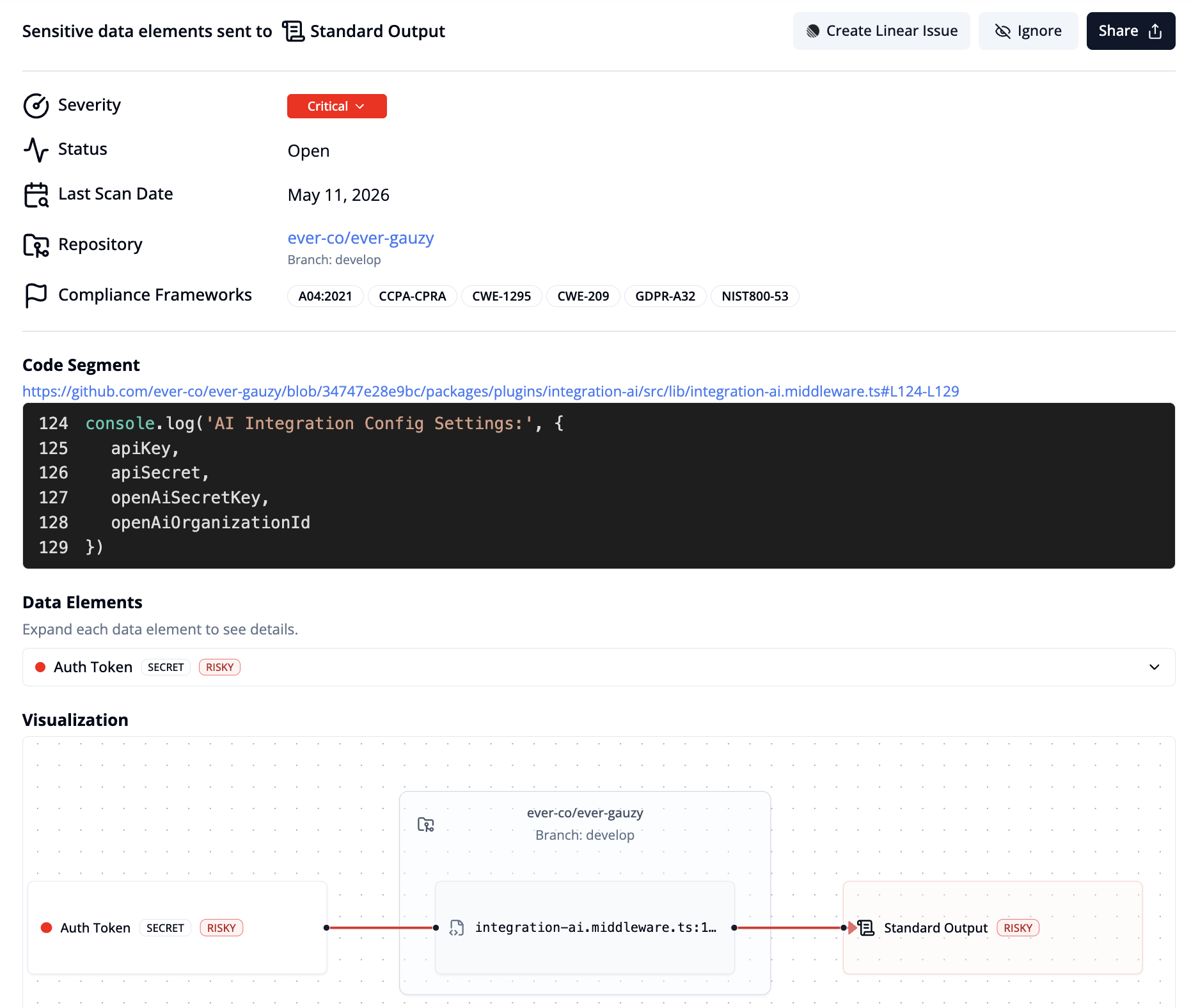
Expanding AppSec coverage with PII leak detection
The scanner detects unintentional PII exposure across logs, files, tokens, cookies, and third-party integrations, reduces the PII footprint in production in line with an "Assume Breach" security model, and supports privacy by design by integrating sensitive data checks early in development.
Covered data sinks for PII exposure risks: logs, files, cookies, tokens, and third-party integrations. These map to the following security categories:
| Security Category | Description |
|---|---|
| CWE-201 | Information Exposure Through Sent Data |
| CWE-209 | Information Exposure Through an Error Message |
| CWE-210 | Self-generated Error Message Containing Sensitive Information |
| CWE-312 | Cleartext Storage of Sensitive Information |
| CWE-313 | Cleartext Storage in a File or on Disk |
| CWE-315 | Cleartext Storage of Sensitive Information in a Cookie |
| CWE-359 | Exposure of Private Personal Information to an Unauthorized Actor |
| CWE-532 | Insertion of Sensitive Information into Log File |
| CWE-539 | Use of Persistent Cookies Containing Sensitive Information |
| OWASP ASVS 7.4.1 | Application Security Verification Standard, error handling |
| OWASP ASVS 7.1.1 | Application Security Verification Standard, log content |
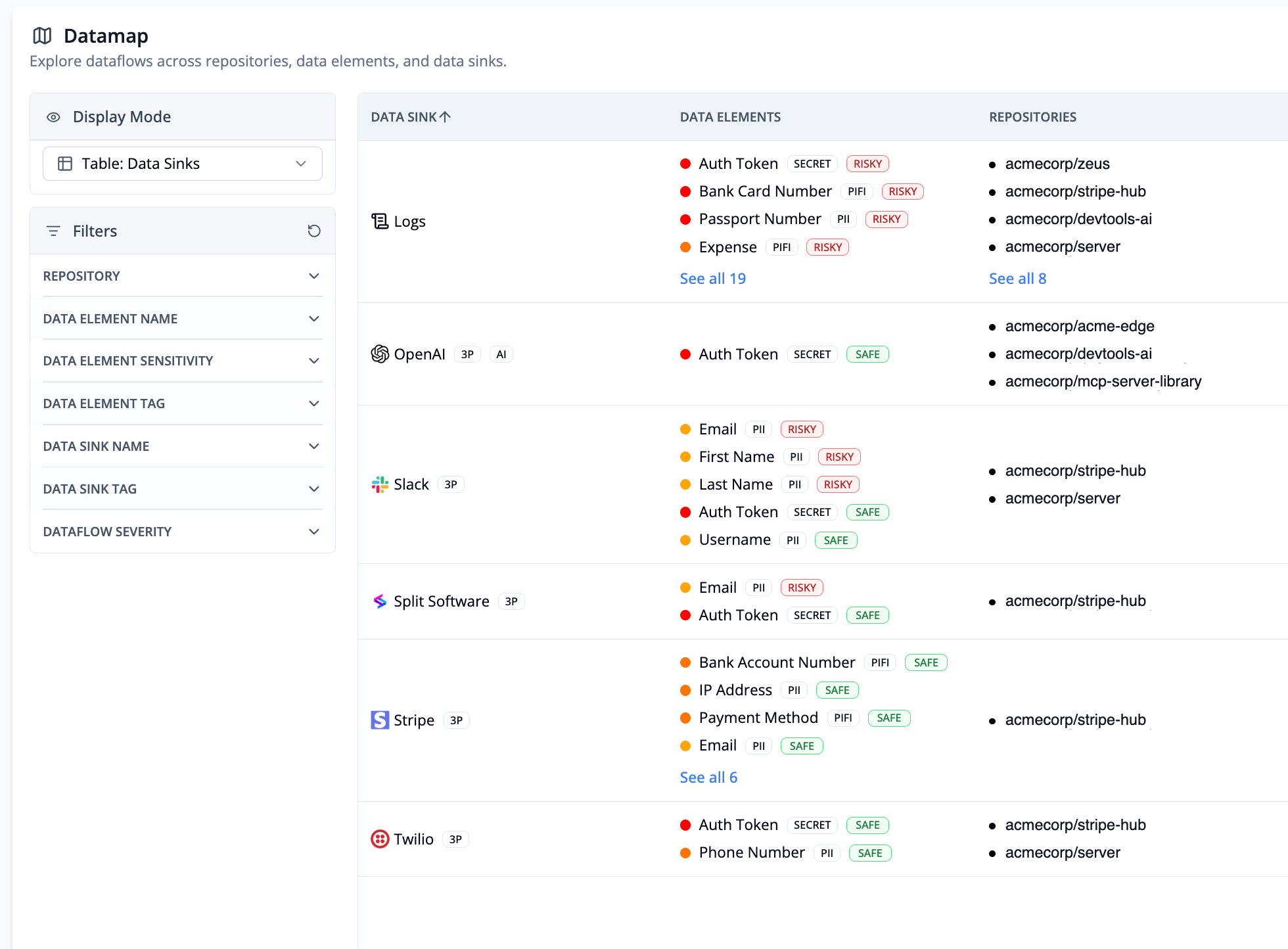
Enhancing risk prioritization based on PII sensitivity
HoundDog.ai generates a PII inventory detailing what sensitive data is processed within a code repository and assigns sensitivity levels (an SSN carries more risk than an email address, for example), helping teams prioritize the most critical issues first.
Why AppSec Teams Need the HoundDog.ai Connector in Brinqa
PII accounted for 92 percent of all compromised data in 2023, which makes it the primary target for attackers. While AppSec teams traditionally focus on securing code vulnerabilities, they often lack visibility into sensitive data flows. At the same time, Data Security Posture Management (DSPM) and Data Loss Prevention (DLP) tools operate reactively, relying on production data rather than addressing security risks at the code level.
This disconnect between Application Security and Data Security creates major gaps: AppSec teams fail to incorporate PII handling in code repositories when prioritizing vulnerabilities, and Data Security teams detect PII exposure after data collection occurs in production, making remediation significantly more complex and costly.
Conclusion
The HoundDog.ai connector for Brinqa closes the missing link between vulnerability management and data security. By ingesting PII leak findings and PII inventories, organizations can expand vulnerability coverage to include PII leaks that are extremely difficult to remediate post-production, enhance risk scoring by factoring in the sensitivity of the data being processed, and bridge the gap between AppSec and Data Security teams by proactively detecting and mitigating PII exposure in the code before it reaches production.
With Brinqa and HoundDog.ai, organizations can adopt a privacy-first security approach, ensuring that sensitive data remains protected while reducing remediation costs and strengthening their overall security posture. Ready to learn more? Let's chat.