

GDPR compliance can be complex, particularly with maintaining accurate Records of Processing Activities (RoPA), conducting Data Protection Impact Assessments (DPIAs), and overseeing third-party processors as required under Articles 30, 35, and 28. Most privacy teams face bottlenecks in the data mapping process, which underpins all critical reporting activities under GDPR. Today, this process is highly manual, often relying on back-and-forth communication with application owners to complete surveys and spreadsheets documenting changes to data flows and sub-processors. The process must be repeated for every audit period or inquiry, and the challenge grows as the number of applications and development velocity increase. A company with thousands of code repositories may have a privacy team perpetually overwhelmed, struggling to keep up with code changes and reacting to third-party data violations and PII updates only after the data is in production.
This article demonstrates how privacy teams can adopt GDPR compliance software that works at the speed of development, automating data mapping, reporting, and the detection of policy-based violations like PII oversharing with third-party integrations.
Keeping Track of PII: Simplifying Records of Processing Activities (GDPR Article 30)
Maintaining accurate Records of Processing Activities
GDPR Article 30 requires you to maintain detailed Records of Processing Activities covering how PII is collected, processed, and shared within your organization and with third parties, including data categories, processing purposes, and external data transfers.
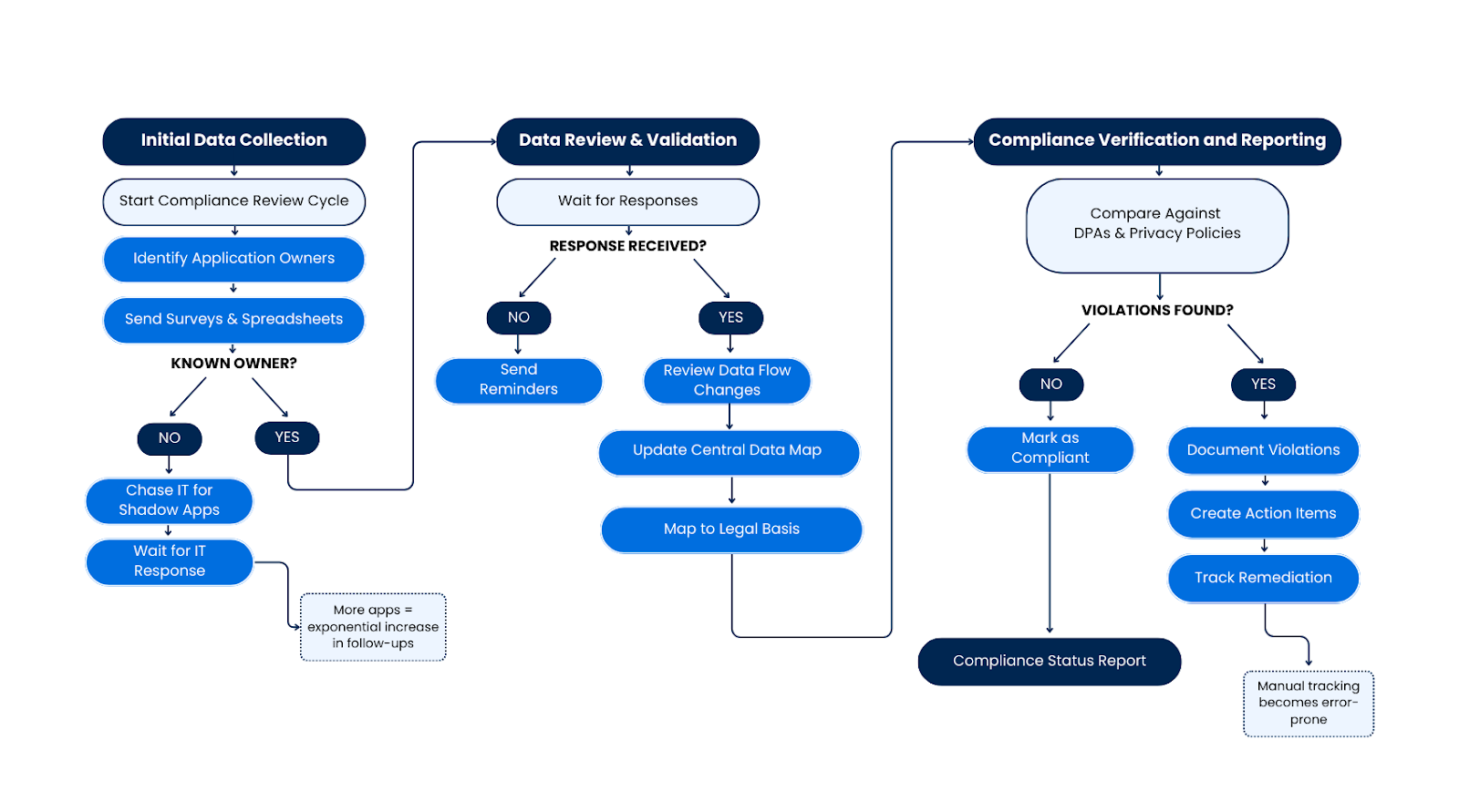
Maintaining up-to-date records is a significant challenge, especially as the number of applications and development speed grow. The data mapping process, fundamental to GDPR reporting, is largely manual and relies on frequent back-and-forth communication with application owners to complete surveys and spreadsheets documenting changes in data flows and sub-processors. The manual nature of this process, coupled with the complexity of data relationships that require ongoing validation, heightens the risk of errors and outdated documentation. This can result in non-compliance and challenging audit outcomes. The workflow below exemplifies the tedious steps required to track data flow changes for GDPR compliance.
How HoundDog.ai helps

The HoundDog.ai static code scanner runs as part of the CI pipeline, ensuring continuous mapping of PII data flows across all storage mediums and third-party integrations where it is exposed. With this approach, the HoundDog.ai Cloud Platform automates the data mapping process and surfaces suggested updates to your organization's Records of Processing Activities based on what the scanner detects in code, with your privacy team owning the review and approval of every change. It also enables privacy teams to proactively address potential violations, such as oversharing PII with third-party integrations in breach of data processing agreements, or introducing new types of PII without proper privacy reviews to ensure lawful processing. This eliminates the need for manual follow-ups while making compliance simpler and more accurate.
Beyond keeping the RoPA current, the platform lets you visualize how PII moves internally and through third-party connections, ensuring no flow is overlooked. Automated data flow diagrams provide a clear view of how personal data is processed and shared across all storage mediums and third-party integrations, verifying compliance with Data Processing Agreements (DPAs).
Preventing compliance gaps with proactive data flow tracking
Proactive monitoring keeps your data flow maps current, reducing the need for manual reviews and complex data extraction efforts. The platform continuously tracks PII and updates your documentation to reflect changes before code is pushed to production, helping you catch undocumented data flows or unexpected changes early, before they become compliance issues during audits. With a continuously updated PII inventory, reporting and audits become smoother: accurate, current records mean less scrambling when auditors request documentation, less risk of non-compliance, and confidence that you are always audit-ready.
Handling Complex Risk Assessments: Automating Data Protection Impact Assessments (GDPR Article 35)
As GDPR Article 35 states, you need to conduct Data Protection Impact Assessments when processing activities may pose a high risk to individuals' rights and freedoms. These assessments help you find and address potential privacy risks.
Identifying these risks during development can be challenging, especially when PII is hidden in code, buried in logs, or passed through third-party APIs. Without full visibility, DPIAs might miss important details, leading to compliance issues and stress during audits.
There is a second, more dangerous gap: privacy reviews conducted in the design phase are only as good as the implementation that follows. Teams go through extensive DPIA reviews during design, sign off on a data handling plan, and are then surprised by code in production that does not meet the assessed requirements, because no check was ever conducted against the code itself. A new field added to a payload, an extra log statement, an SDK swapped in during a sprint: none of these trigger a new design review, and all of them can invalidate the assessment. The DPIA ends up describing the system you intended to build, not the one you shipped.
How HoundDog.ai helps

HoundDog.ai closes that gap by validating design-phase privacy reviews with code-based evidence. Because the scanner reads the source code on every commit, the data flows it detects are compared against what the DPIA assessed, so a divergence between the approved design and the actual implementation surfaces during development instead of in production.
The HoundDog.ai Cloud Platform gives you a powerful way to maintain a detailed inventory of PII throughout your codebase. It tracks PII exposure within your source code, offering visibility into potential data handling risks without scanning unstructured data like logs, files, or APIs. This makes risk identification and DPIA documentation far more efficient, reducing the need for time-consuming manual searches.
Automated updates keep your PII records current, in line with Article 35 requirements, so you avoid outdated or incomplete data when preparing for audits or providing DPIA documentation. Continuous PII monitoring helps you spot potential risks early in the development process, assess and manage them before code goes live, and reduce the chance of costly post-production fixes. Integrating this proactive monitoring into your processes makes audits less stressful and lets you demonstrate that your organization meets GDPR standards and protects personal data throughout its lifecycle.
Ensuring Third-Party Accountability: Strengthening Processor Oversight (GDPR Article 28)
GDPR Article 28 mandates that you monitor your third-party processors and ensure they comply with their data protection obligations. This includes assessing their ability to meet GDPR standards and maintaining oversight of their data handling practices.
The challenge comes when frequent third-party integrations occur during development, making it difficult to keep track of every interaction. This lack of visibility can lead to non-compliance and potential data mishandling, affecting your entire compliance strategy.
How HoundDog.ai helps

Tracking third-party data flows can be complicated, but HoundDog.ai simplifies the process by monitoring these interactions at the speed of development. The platform monitors data flows before code is pushed to production, identifying compliance risks and potential issues before they escalate. If any Data Processing Agreement violations are detected during development, the platform flags them, allowing your team to address concerns early on.
This proactive tracking means you do not have to wait for audits or production to determine whether PII was overshared with third-party integrations. By keeping third-party interactions transparent and documented, you maintain better oversight and align with Article 28 requirements.
Critically, your DPAs and privacy policies are not just reference documents in this model; they are baked into the scanner as custom allowlists per data sink. For every processor your applications integrate with, you define exactly which data elements that processor is contracted to receive under its DPA. Anything outside the allowlist, whether a new data element a developer wires in or an expanded payload on an existing integration, is flagged as a violation before the code merges. The contract becomes an enforceable, testable policy rather than a PDF nobody checks against the code.

Avoid costly remediation by addressing issues pre-production
Catching potential non-compliance issues with third-party processors before the code goes live saves time and money. Proactive monitoring helps you manage these risks during development, preventing costly fixes and last-minute adjustments later. Early identification of third-party risks helps you avoid expensive remediation efforts, keeps your data handling practices compliant, and reduces the chances of facing penalties or setbacks due to data mishandling.
Conclusion
We have covered the main challenges of GDPR compliance, including managing RoPA, DPIAs, and third-party oversight, and how HoundDog helps automate these tasks with proactive PII tracking and risk monitoring. Automating your compliance efforts saves time, reduces human error, and aligns your data protection practices with regulations. To simplify your GDPR compliance and minimize risk, book a call with HoundDog.ai and discover how we can help.