Live demo · MozFest 2026

HoundDog.ai ProtoMap Demo at MozFest

Live demo of HoundDog.ai's ProtoMap at MozFest's Open Source House.

10:53 Open Source House, MozFest October 29, 2026
The problem

You prompt your AI coding agent to assess the impact of changing a service, API or field name, and the agent goes off trying to rediscover the relationships and dependencies in your codebase, while you wait minutes and the agent is charging you tokens for this discovery. API specs (like protobuf files) help, but they don't cover which services actually call an API. And the agents do not even get access to all of the org's code repos because they can only see whatever is checked out on the dev machine.
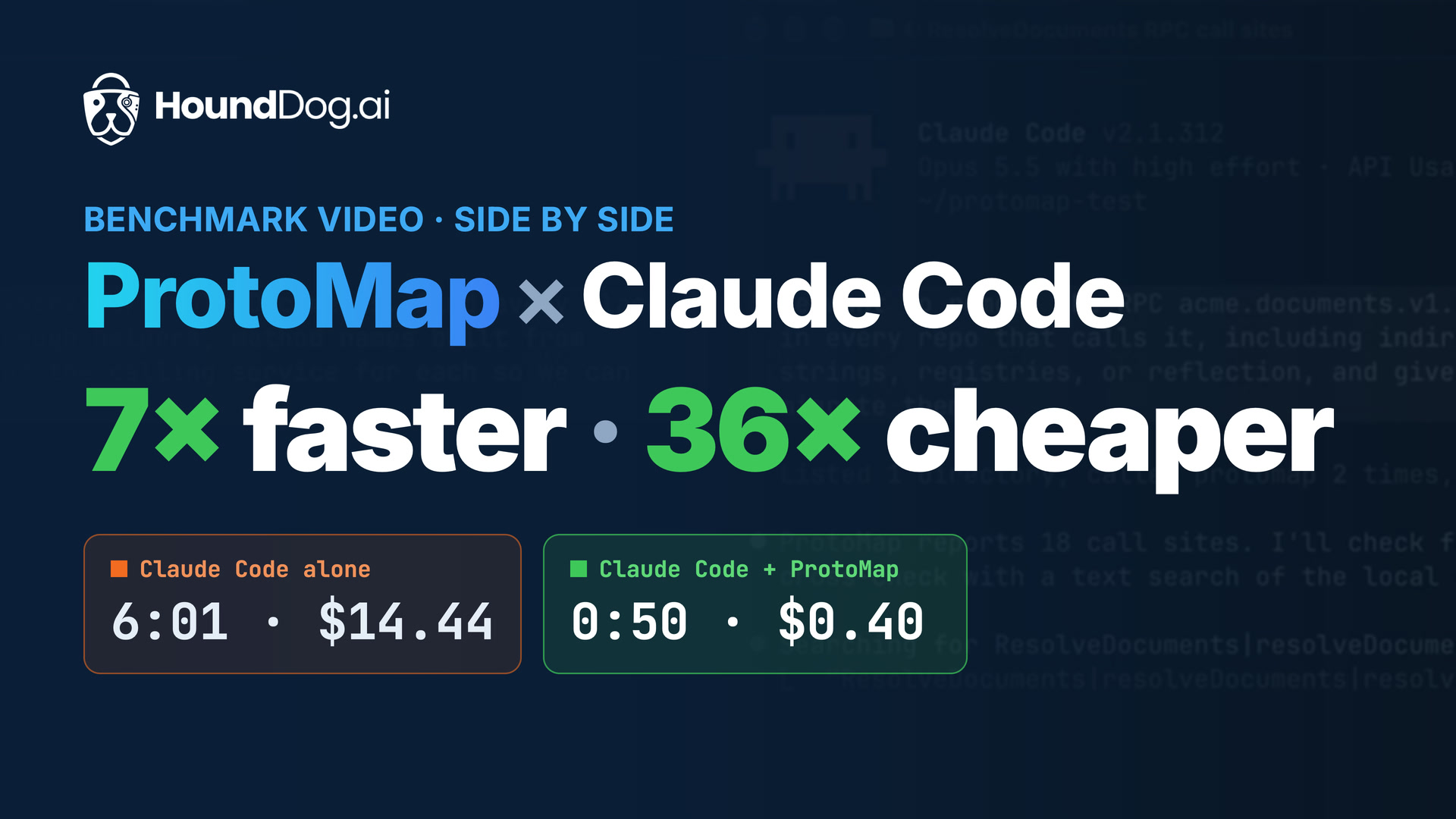
The solution

ProtoMap is a deterministic service graph that maps every service, API and field name across your entire organization's code. It gets updated with every commit and does not need any AI tokens. It plugs into your org's CI using standard CPU runners. Engineers prompt the service graph in plain English and visualize service and API relationships across multiple hops. Your AI coding agent gets the same service graph via MCP. For an enterprise customer with a multi-million-line monorepo, this translates to an 8X reduction in tokens and time for change-planning tasks.

8×

reduction in tokens and time for change-planning tasks.

Enterprise customer · multi-million-line monorepo
6.4×

faster and 5.3× cheaper per prompt with the ProtoMap MCP server.

0

AI tokens to build the graph. It gets updated with every commit.

Standard CPU runners in your CI
In this video

Chapters

01Introduction
02The problem: AI coding agents rediscover dependencies
03ProtoMap: a deterministic service graph
04Live demo
05The service graph: callers and callees
06Which services depend on ClinicalEncounterCoordination?
07Blast radius of changing a field name
08Benchmarks: Claude Code with and without the ProtoMap MCP server
09Wrap-up

Stop wasting tokens on discovery.

Install the self-hosted ProtoMap platform and CLI scanner for free, and give your engineers and agents org-wide context.