
Automated GDPR Data Mapping, RoPA, and Privacy Assessments
Surface new data flows and subprocessors as suggested edits to Records of Processing Activities (RoPA). Verify Privacy Impact Assessments with code-level evidence before code ships.
Make Privacy-by-Design a Reality in Your SDLC
Manual GDPR data mapping and privacy assessments are slow, incomplete, and outdated the moment they are published. Most data privacy platforms are a step up from spreadsheets, but they are still reactive, flagging risks only after data hits production.


Map every data flow in your codebase

from simple_salesforce
import Salesforce

from hubspot
import HubSpot

from amplitude
import Amplitude, BaseEvent

Automatically build a complete view of how personal data is collected, transformed, and shared across your application, including third-party SDKs, APIs, and AI integrations. No surveys, no self-reporting.

from datadog
import DogStatsd

import sentry_sdk

import analytics

Back every privacy record with code-level evidence


Detect developer (or AI-generated) mistakes that leak sensitive data into logs, files, local storage, and other risky areas.

Logs

Files

Local Storage

Cookies

JSON Web Tokens
Keep privacy documentation current as code evolves

Eliminating Guesswork in Data Flow Mapping with Code Level Evidence
Subprocessor Discovery for Your RoPA and DPAs
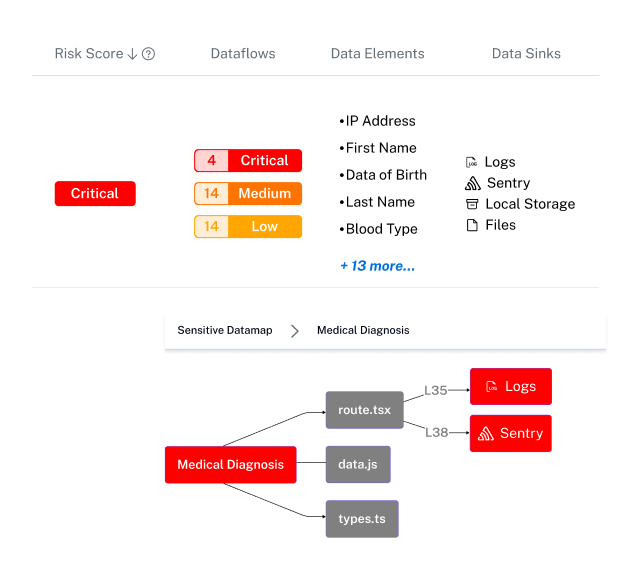
Disadvantages of Current Approaches:

Most platforms rely on identity providers or network traffic to detect third-party integrations, which only reveals tools that have already been authorized or are actively used.

These methods miss SDKs, open-source packages, and homegrown integrations embedded directly in code, leaving security teams blind to Shadow IT.
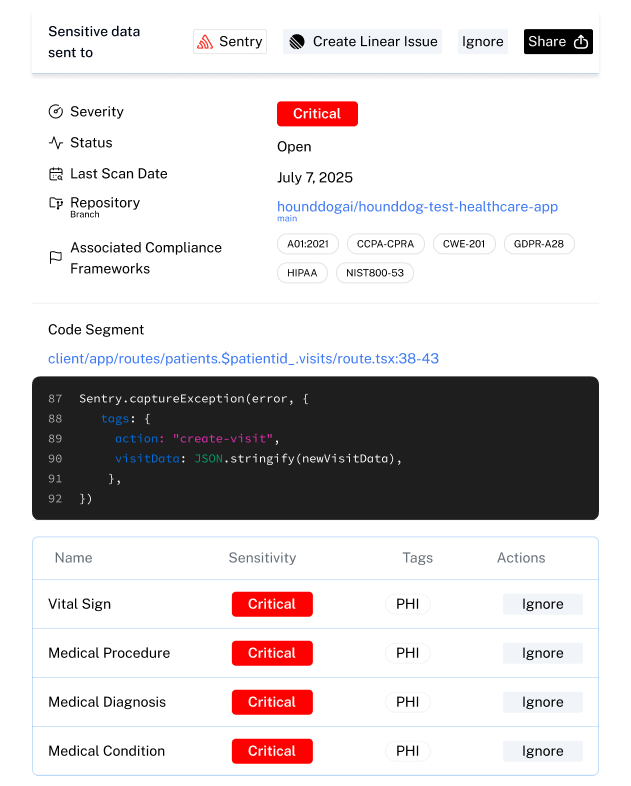
Advantages of HoundDog.ai's Approach:

HoundDog.ai discovers third-party SDKs and APIs directly in the codebase before they are deployed or granted access to data.

This early detection gives security and privacy teams full visibility into both sanctioned and unsanctioned third-party integrations across the development lifecycle.

New subprocessors are surfaced as part of the CI workflow, so privacy teams can update the RoPA before the code ships.
Subprocessor Discovery for Your RoPA and DPAs
Disadvantages of Current Approaches:
Most platforms rely on identity providers or network traffic to detect third-party integrations, which only reveals tools that have already been authorized or are actively used.
These methods miss SDKs, open-source packages, and homegrown integrations embedded directly in code, leaving security teams blind to Shadow IT.
Advantages of HoundDog.ai's Approach:
HoundDog.ai discovers third-party SDKs and APIs directly in the codebase before they are deployed or granted access to data.
This early detection gives security and privacy teams full visibility into both sanctioned and unsanctioned third-party integrations across the development lifecycle.
New subprocessors are surfaced as part of the CI workflow, so privacy teams can update the RoPA before the code ships.
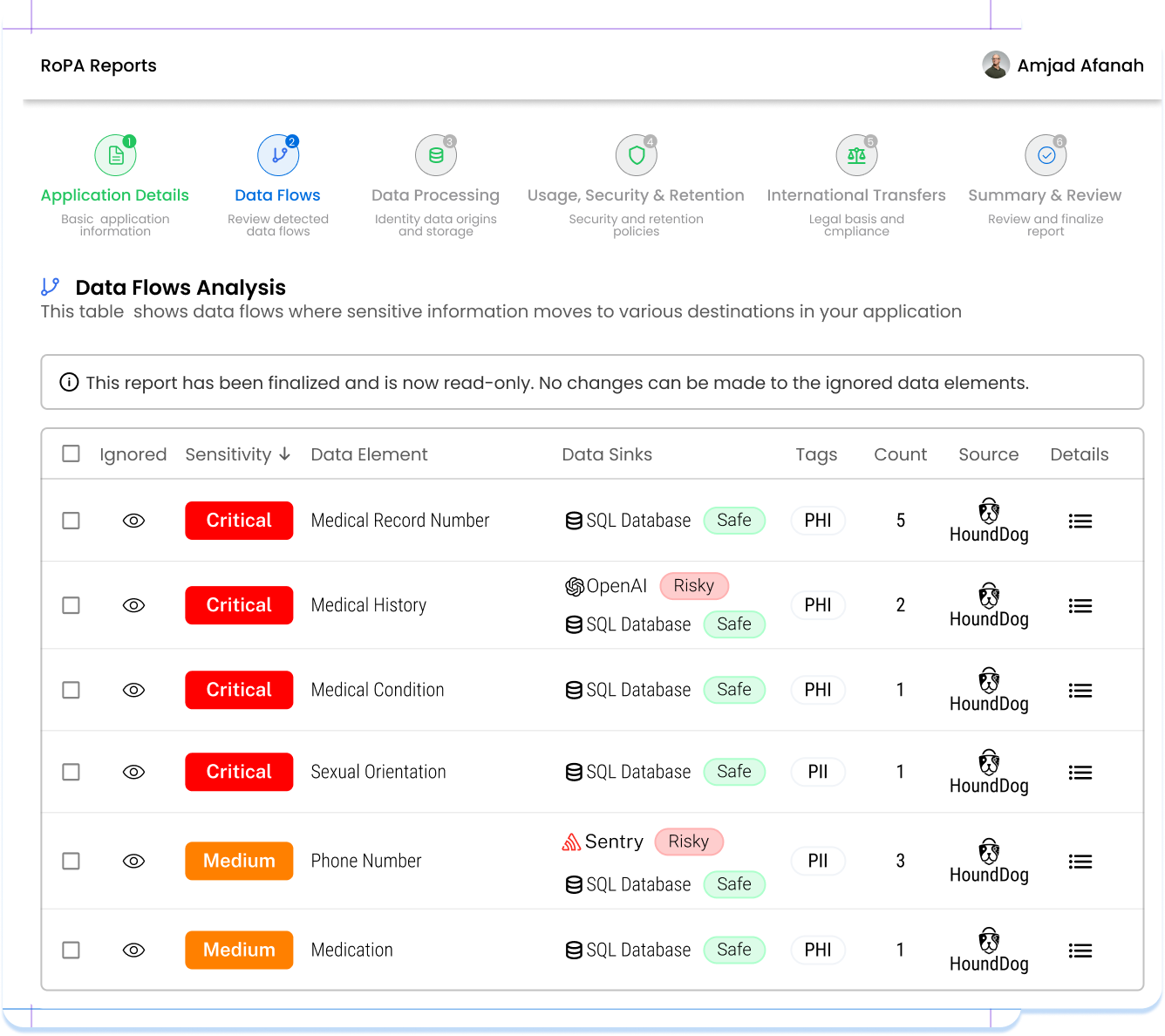
Evidence-based GDPR Data Mapping and Privacy Impact Assessments
Disadvantages of Current Approaches:
 Privacy assessments are typically manual, relying on surveys or observations after deployment that fail to capture what actually happens in the code.
 Most tools lack visibility into how sensitive data flows to third party SDKs or external APIs, relying on manual surveys or production analysis that misses shadow AI and new integrations in code.
 RoPAs, PIAs and DPIAs are often incomplete or quickly outdated, especially in fast-moving engineering environments.
Advantages of HoundDog.ai’s Approach:
 HoundDog.ai automatically maps data flows in code, showing where sensitive data is collected, processed, and shared, including through third-party integrations
 It provides audit-ready evidence for RoPAs, PIAs, and DPIAs, backed by code-level data flow traces that privacy teams can verify directly.
 Privacy teams get continuous, real-time visibility into technical processing activities in code, without relying on engineering self-reported surveys.
Enabling Automated GDPR Data Mapping Across All Stages of Development

IDE Plugins
Detect sensitive data leaks directly in your IDE as you write code.
Catch privacy risks early before they reach production.


Managed Scans
Offload scanning to HoundDog.ai with direct source control integrations.
Automatically analyze repositories for privacy risks.


CI/CD Integrations
Use HoundDog.ai source control integrations to auto configure CI.
Block risky pull requests before they are merged.


DIY PII Detection Doesn’t Scale
Hardcoded RegEx rules break easily and are a nightmare to maintain. Most DIY efforts stall before they scale
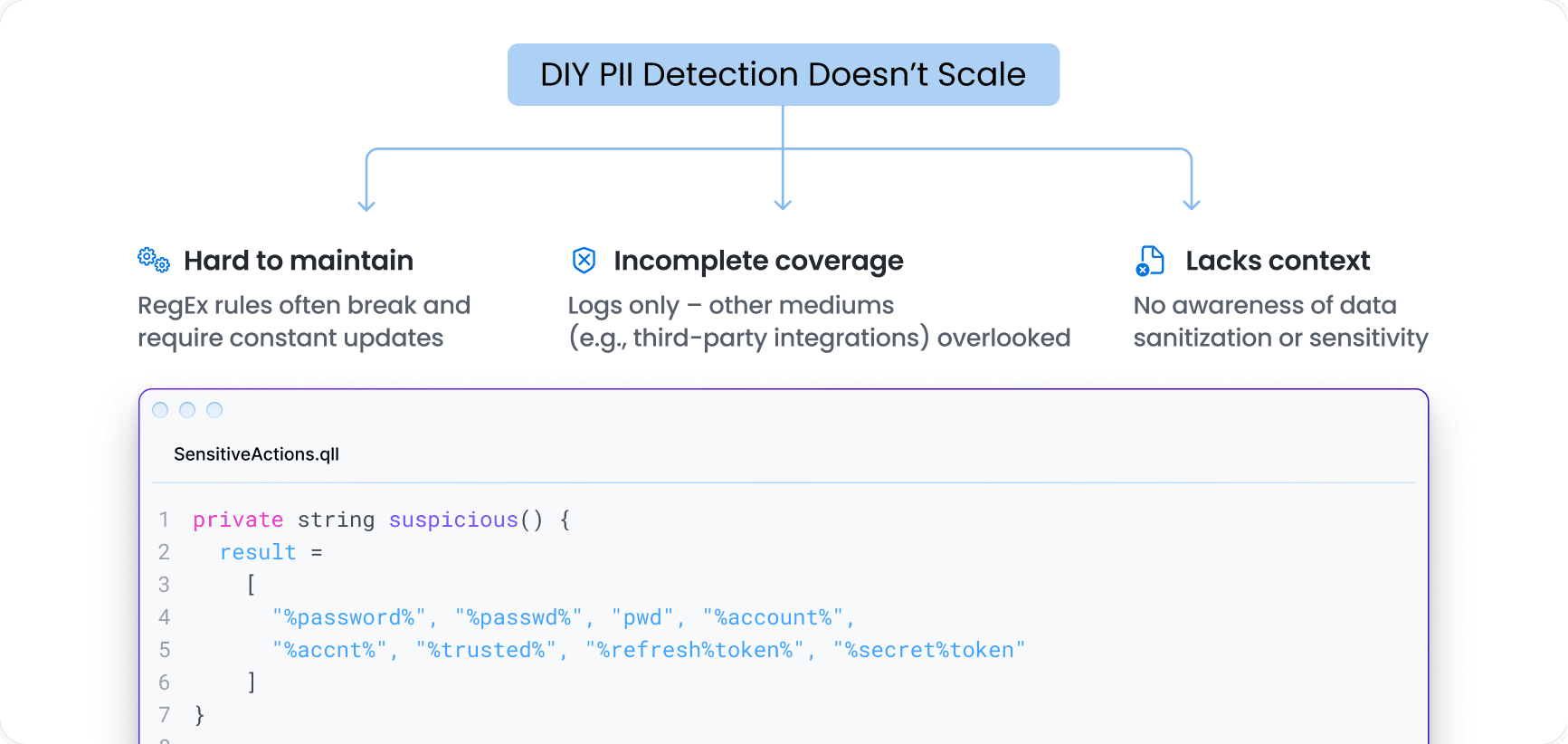
HoundDog.ai: Purpose-Built for PII Detection & Data Mapping

Unparalleled Coverage and Accuracy
Built-in detection with extensive coverage across:
- Sensitive data elements (PII, PHI, PIFI, CHD)
- Risky data sinks (including hundreds of third-party integrations)
- Sanitization functions (flag only when data isn’t properly sanitized)

Endless Flexibility
- Finetune detection across data elements, sinks, and sanitization to fit your environment.

Ready to Scale
- Connect to GitHub, GitLab, or Bitbucket to scan code, block PRs, and leave actionable comments – automatically.
- Managed Scans: Offload scanning to HoundDog.ai for continuous, hands-off coverage
- CI Jobs: Push CI configs to selected repos using your self-hosted runners, with options for direct commits or approval-based PRs

AI-Ready
- [Coming Soon] AI-powered detection that plugs into any LLM running in your environment – boosting coverage across data elements, sinks, and sanitization, while minimizing manual tuning.
Realize Significant Cost Reduction and Increased Productivity
ROI for automated privacy compliance

Why Shift-Left Privacy Matters
Stop privacy risks at the source — while code is being written, not after it reaches production.

AI Exposure Happens Fast
Sensitive data can be exposed to AI tools
within minutes of code changes.

Post-Production Tools Are Too Late
Fixing leaks after release
doesn’t prevent real damage.

Compliance Requires Prevention
Modern privacy programs must prevent risks,
not just report them after exposure.

Trusted by Replit to detect privacy leaks across AI generated applications built by more than 45 million creators.

Make Privacy-by-Design a Reality in Your SDLC
Shift left on privacy with code scanning. Detect PII leaks, map sensitive data flows, and generate GDPR data maps, RoPA, PIA, and DPIA before code reaches production.